

27.11.2026 18:23
Housing from a housing association in the Netherlands. Who can get it and how do you register?
Are you looking for accommodation in the Netherlands and comparing offers? You can also search through a housing association, but registering alone does not guarantee that you will get a home.
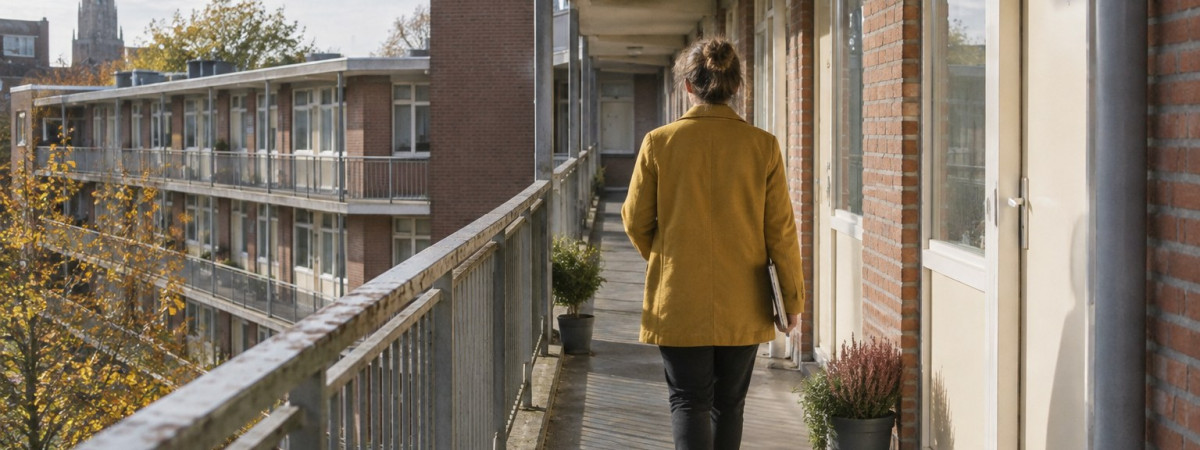
Documents proving your income must be brought to the viewing of a housing association property. Zdjęcie wygenerowane przez sztuczną inteligencję
What kind of home can you get and how much does it cost?
As a worker from Poland, you can look for housing through a housing association, and whether you can get it depends on your income. Housing associations also offer mid-market homes, which are also rented out by private landlords.
The following amounts apply in 2026:
The following amounts apply in 2026:
- Social housing: for a new contract, the basic rent, known as kale huur and excluding additional charges, is no more than EUR 932.93 per month.
- Mid-market housing, known as a middenhuurwoning: the basic rent is above EUR 932.93 but no more than EUR 1,228.07 per month.
How much can you earn?
For social housing from a housing association, the income thresholds in 2026 depend on who you will be living with:
Your total income from work and housing, dividends and shares, as well as investments and savings, is taken into account. Also check the conditions concerning the number of household members: for a specific property, your family may be too large or too small.
For the mid-market segment, check the requirements of the specific housing association and the listing. For example, in 2026 Eigen Haard applies the following annual thresholds:
Eigen Haard does not accept foreign income for mid-market and free-market homes. Before applying, check the listing for the minimum and maximum income and the target group for the offer.
- A person living alone: EUR 51,537.
- A multi-person household, such as a family: EUR 56,910 in combined income.
Your total income from work and housing, dividends and shares, as well as investments and savings, is taken into account. Also check the conditions concerning the number of household members: for a specific property, your family may be too large or too small.
For the mid-market segment, check the requirements of the specific housing association and the listing. For example, in 2026 Eigen Haard applies the following annual thresholds:
- A person living alone: at least EUR 51,538; above EUR 70,149, they may respond to mid-market offers only in Amsterdam.
- A multi-person household: combined income from EUR 56,911 to EUR 93,531.
Eigen Haard does not accept foreign income for mid-market and free-market homes. Before applying, check the listing for the minimum and maximum income and the target group for the offer.
Where do you register and what happens next?
Registering alone is not enough; you must also respond to specific listings.
After applications close, the home is usually offered to the person with the longest registration period. At Eigen Haard, you need to be registered with Mijn Dak (WoningNet) to respond to mid-market and free-market offers.
Also follow the rules of your portal: at DĀK regio Utrecht, failing to respond to a housing offer may result in your registration being blocked. Failure to pay the registration or renewal fee results in deregistration.
Accepting a home also automatically removes you from the seekers' list at DĀK regio Utrecht. If you register again within a year, you will recover 75% of your previous registration time.
- On socialehuurwoning.nl, search for a town, municipality or region and go to the relevant portal for registration and listings.
- Register and express interest in the homes you choose.
- Prepare the required documents in advance: for example, Eigen Haard requires them immediately after viewing the home.
After applications close, the home is usually offered to the person with the longest registration period. At Eigen Haard, you need to be registered with Mijn Dak (WoningNet) to respond to mid-market and free-market offers.
Also follow the rules of your portal: at DĀK regio Utrecht, failing to respond to a housing offer may result in your registration being blocked. Failure to pay the registration or renewal fee results in deregistration.
Accepting a home also automatically removes you from the seekers' list at DĀK regio Utrecht. If you register again within a year, you will recover 75% of your previous registration time.
Do you always have to wait a long time?
Not every offer depends on the years you have spent on the list: a small number of homes are allocated by lottery, known as loting. A short registration period does not reduce your chances in a lottery, although people with an urgent housing need have priority.
There are also homes available directly: the offer goes to the first person who responds and meets all the conditions. For these offers, an urgentieverklaring does not give priority. For a standard offer, the certificate gives priority, but you still need to respond to it.
At Woonin, waiting time depends on the neighbourhood and the type of home, and the housing association does not provide a predictable average. On DĀK regio Utrecht, you can check the registration period of the person who received a home in allocated listings. This allows you to compare your own registration period with the results of previous allocations.
Can you receive a rent allowance?
You may be entitled to huurtoeslag, a rent allowance, if you meet, among other things, the conditions concerning income, assets and the home. From 2026, rent exceeding the limit used for calculations (normally EUR 932.93) does not in itself exclude you from receiving the allowance.
You must live in a self-contained dwelling, referred to as a zelfstandige woning. You, your partner and any other co-residents aged 18 or over must be legally resident in the Netherlands.
There is no single income limit for everyone: it depends on the rent, age and household composition. Calculations use toetsingsinkomen, an income figure similar to gross income but usually slightly higher.
The income of a toeslagpartner, meaning a partner included for benefit purposes, and medebewoners, meaning co-residents, is also taken into account. The income of subtenants is not included, and part of the income of children living with a parent is disregarded in the calculation.
The following asset limits apply for 2026:
If your spouse or registered partner is not registered at your address, their income and assets are not included for huurtoeslag. However, they are taken into account for other benefits.
You must live in a self-contained dwelling, referred to as a zelfstandige woning. You, your partner and any other co-residents aged 18 or over must be legally resident in the Netherlands.
There is no single income limit for everyone: it depends on the rent, age and household composition. Calculations use toetsingsinkomen, an income figure similar to gross income but usually slightly higher.
The income of a toeslagpartner, meaning a partner included for benefit purposes, and medebewoners, meaning co-residents, is also taken into account. The income of subtenants is not included, and part of the income of children living with a parent is disregarded in the calculation.
The following asset limits apply for 2026:
- Without a benefits partner: assets of no more than EUR 38,479 on 1 January 2026.
- With a benefits partner: combined assets of no more than EUR 76,958.
- Each co-resident: assets of no more than EUR 38,479, so that their assets do not exclude the allowance.
If your spouse or registered partner is not registered at your address, their income and assets are not included for huurtoeslag. However, they are taken into account for other benefits.
How do you check and apply for the allowance?
Start with a proefberekening, a trial benefits calculation, to check whether you may receive the allowance and how much it could be. You can then apply for huurtoeslag through Mijn toeslagen.
In 2026, calculations normally use a rent of no more than EUR 932.93 per month. If the oldest household member is under 21, the limit is EUR 498.20. Therefore, if you live with an older person, their age is used rather than yours.
